
Friday, April 18, 2025

Wednesday, January 1, 2025
Christmas Giving From Dogwood Circle
Marvine Thompson and Betty Waldrep, Co-Circle Leaders, for Dogwood Circle met with the
Executive Director of Divine Mercy House. They presented her with a check for $567 collected at the Dogwood Christmas party. The Dogwood Circle wanted to help a local organization during the Christmas Season.
Executive Director of Divine Mercy House. They presented her with a check for $567 collected at the Dogwood Christmas party. The Dogwood Circle wanted to help a local organization during the Christmas Season.
Divine Mercy House is a 4000sq. ft. home for unwed mothers and their children. The home is supported by St. Joseph’s Catholic Church and donations from the community.
Marvine and Betty were given a tour of the home and the Director and her Assistant told us all about how the home operates. The women are helped during their pregnancy and after giving birth. Theyare helped with schooling, work, and life skills.
Thank you Dogwood for helping this worthy organization.

Monday, October 14, 2024

Monday, August 26, 2024
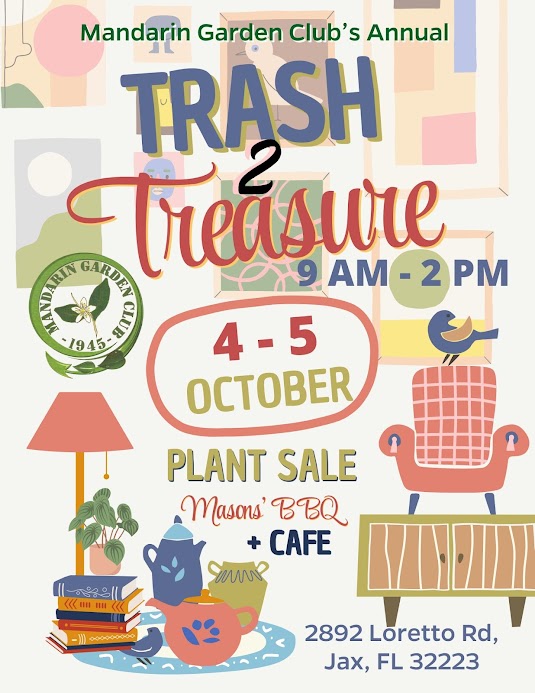
Gigantic Garage Sale
Mark your calendars for our annual Trash 2 Treasure Sale. We have items from over 200 members. Something for everyone!
Saturday, August 24, 2024
WHO IS THIS NURSERY MAN?
On September 26, 1774, John Chapman was born in Leominster, MA and died from pneumonia, at 71 years of age in Ft. Wayne, Indiana. He worked as an apprentice for an orchard grower named Mr. Crawford and became a leader in conservation and was recognized for the value he placed on apples. He became known as a pioneer nurseryman and conservationist. His boss had a large apple orchard and this is believed to have been the inspiration for him going on a journey to plant apple trees. When he turned 18, he convinced his brother, who was 11 at the time, to go west and travel with him. The two brothers led a nomadic life moving from place to place and finding work before moving to a new location. Chapman was known for having a threadbare wardrobe. This usually did not include shoes, but it did include him having a tinpot he used for a hat as well as cooking. Soon thereafter his brother opted out and returned home.
Some believe that he planted apple trees in a random fashion but everything he did was actually based on providing an economic benefit. He would travel around and establish apple nurseries with plants from Mr. Crawford’s nursery. He didn't randomly spread apple seeds, he worked to carefully plant apple nurseries rather than apple orchards. He built fences around them to protect the plants from livestock. The nurseries were left to be cared for by neighbors who would eventually be able to sell some of the trees as payment for their time.
Chapman would travel and tell stories to children as well as preach the gospel. He would also preach at churches. He was often provided with meals as well as a floor to sleep on for the night. The apple trees he planted served various purposes. Most of them were not grown to provide edible fruit but the small, tart apples grown in his orchards were used to make hard apple cider, which was also referred to as applejack. His apple orchards also served a legal purpose. They established his claim to the land where they were planted. Toward the end of his life, Chapman owned approximately 1,200 acres of land that was considered quite valuable. John Chapman's image became that of Johnny Appleseed. Towards the end of his life, he was an obsessive vegetarian. He didn't believe in marriage, as he felt he would ultimately be rewarded in the afterlife for following a path of abstinence and he would find his soulmate in heaven.
Submitted by ~
Laura Miller
History & Awards
Tuesday, July 2, 2024

Thursday, March 14, 2024

Tuesday, February 27, 2024

Monday, December 11, 2023
Exciting New Garding Series
It's official! We are now in zone USDA 9B. For years we have been designated USDA 9A - time to learn where our gardening endeavors will lead in 9B.
Our Live Oak Circle will be hosting an exciting 5 part series beginning January, 2024.
Details below -

Friday, October 13, 2023

Tuesday, September 26, 2023

Thursday, March 2, 2023
Spanish Moss (Tillandsia usneoides)
Spanish Moss is a flowering plant in the pineapple family, so it’s not a moss at all. It is an epiphyte or air plant found in damp areas near waterways or swamps because it absorbs its moisture and nutrients from the air. It is not a parasite like mistletoe and does not rob the host tree of water or nutrients. It is covered with scales or flaps on its surface which allows it to absorb moisture from the air and catch the dust particles which are needed for nutrients. These scales or flaps (also called trichomes) slow down transpiration so that the plant doesn’t dry out too quickly.
Believe it or not, Spanish Moss is a flowering plant; the yellow-green to red flowers are so small that they are nearly imperceptible. The flowers bloom in the summer, last only a few days, and emit a subtle fragrance which attracts a variety of insect pollinators. Fruit, in the form of tiny capsules, release the seeds the following winter and this dispersal is aided by delicate hairs, almost an inch long, which act as kites. These hairs are covered with tiny barbs which can anchor in the cracks of rough tree bark. The seedlings have root-like holdfasts but they never penetrate the host tree and don’t last long because the
mature plant has no roots at all. Spanish Moss reproduces more commonly by vegetative reproduction than by seed dispersal. Small broken fragments are scattered by wind, birds, and other animals and they can float on water as well. If the site is appropriate where a fragment lands, then a new plant will grow. Spanish Moss has the largest native range of any member of the pineapple family. This is due, perhaps, to strong hurricane winds which transport it great distances coupled with its ability to grow to full size from a small piece.
Its value for birds is incalculable. Insects, spiders, mites, and other delicious insects live in Spanish Moss. That is why it is a great place to watch for migrating warblers in the spring and fall as they are primarily insect eaters. Warblers will also build their nests in Spanish Moss and larger bird species will line their
nests with it.
The Native Americans wove it into their clothing and used it to make torches. Early European settlers using it as a binding material in the mortar mix to build log cabins; also, used it for fabric by drying it out and spinning it into coarse yarns. It was also commercially ginned staring in the late 1800s until the 1930s. The outer skin was removed by ginning and used for stuffing material for mattresses and furniture. The upholstery in the Model T Fords and other cars were stuffed with Spanish Moss.
How did it get its name? The Native Americans called it itla-okla (tree hair). They communicated this to the early French explorers who were in a competition with the Spanish explorers. The French explorers named it barbe Espagnol (Spaniard’s beard). The Spanish explorers called it cabello Frances (French hair). The French name, barbe Espagnol, was modified to Spanish Moss and that is the name stuck in
our lexicon.
How did it get its name? The Native Americans called it itla-okla (tree hair). They communicated this to the early French explorers who were in a competition with the Spanish explorers. The French explorers named it barbe Espagnol (Spaniard’s beard). The Spanish explorers called it cabello Frances (French hair). The French name, barbe Espagnol, was modified to Spanish Moss and that is the name stuck in
our lexicon.
Ginny Stibolt
Green Gardening Matters
Thank you to Robyn Freedman for sharing this article from Ginny Stibolt's website. The article was posted with Ginny Stibolt's knowledge and permission.
Wednesday, March 1, 2023
FLAMBOYANCE! A Topiary Menagerie
The Cummer Museum will be hosting their first ever horticultural exhibition. Over 50 Flamingo Topiaries will be on display.
For more information -
https://www.cummermuseum.org/visit/art/exhibition/flamboyance
Tuesday, October 4, 2022
Mandarin Garden Club's October Yard of the Month Award
The Mandarin Garden Club's Yard of the Month has been presented to JoAnne Krestul and Jack Slade.
The award is presented to residents of Mandarin who reflect an effort to maintain the natural beauty of Mandarin. This month's recepients demonstrated a uniqueness with natural beaurty of their garden as well as their aquaponics garden towers.
Congratulations to Joanne Krestul and Jack Slade.


Wednesday, September 28, 2022

Monday, September 26, 2022

Monday, July 11, 2022
.jpg)
Tuesday, April 26, 2022


Friday, January 21, 2022

Subscribe to:
Posts (Atom)